A Brief history of Russia.

800

863 Cyril and Methodius create an early version of Cyrillic.

900

Prince Vladimir converts to Christianity

1000

1100

1147 Moscow founded.

1200

Mongol invasions begin.

1300

1400

Ivan III ceases paying tribute to the Mongols

1500

1533-84 Ivan IV - The Terrible

1600

  • 1613 Mikail Romanov becomes first tsar of the Romanov dynasty.
  • 1672 Peter the Great born. He becomes tsar in 1682 - at the age of ten.

1700

  • War against northern Sweden.
  • 1712 St Petersburg becomes seat of government after the city is founded in 1703
  • 1725 Catherine I becomes empress
  • 1768-74 First Russo-Turkish war
  • 1787-92 Second Russo-Turkish war

1800

  • 1801 Alexander I becomes tsar after murder of Paul I
  • 1809 Satirical writer Nikolai Gogol born
  • 1812 Napoleon invades Russia.
  • 1821 Fyodor Dostoyevski born
  • 1825 Decemberist rebellion. Nicholas I becomes tsar.
  • 1855 Alexander II becomes tsar.
  • 1861 Emancipation of serfs
  • 1865-9 Tolstoy writes "War and Peace"
  • 1881 Alexander III becomes tsar after Alexander II assassinated
  • 1894 Nicholas II

1900

  • 1917 The Russian Revolution
  • 1918 Civil War. Capital moved to Moscow
  • 1922 Stalin becomes General Secretary of the Party.
  • 1931-2 Famine, coupled with Stalin's murderous reign, up to 10 million are thought to have died.
  • 1934 The Purges begin. Over 5 years Stalin has intellectuals and members of the military hierarchy killed. 15 million were arrested, many sent to work camps and over a million were executed.
  • 1940 Nobel Prize winner (literature) Joseph Brodsky born
  • 1941 The siege of Leningrad. 670,000 (mainly civilians) perish in 900 days.
  • 1945 At the end of the Second World War Russian losses were approximately 20 million.
  • 1947 Cold War
  • 1953 Stalin dies
  • 1957 Sputnik
  • 1961 Yuri Gagarin is the first man in space.
  • 1962 Cuban Missile Crisis
  • 1970 Solzhenitsyn wins The Nobel Prize for Literature.
  • 1980 Olympic games Moscow. Boycotted by the West.
  • 1985 Mikhail Gorbachev - General Secretary of Communist Party.
  • 1990 Gorbachev elected President of USSR and is awarded the Nobel Peace Prize.
  • 1991 Boris Yeltsin becomes President. The Communist Party is outlawed.

2000

Russia struggles against economic ruin, right wing propaganda and pornography to redefine itself as a free and equitable nation...though the gap between rich and poor now seems greater than ever...

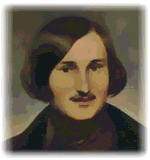
Nikolai Vasilevich Gogol
1809-1852

Looks cute doesn't he? Innocent, sweet, yes, but behind that demure exterior lurks a rapier wit and a passionate soul. No doubt if you want to find out more about Gogol you are smart enough to do that in your search engine, so I'm just going to discuss my own thoughts on the man and his work. This writer is well known for his satirical writing - a style very close to my own heart as you can tell if you have read any of this site. My favourite book is the well known"Dead Souls".

About the story: The novel follows the adventures of Chichikov, a petty official who wants rather more from life than his humble circumstances allow. A person's status can be measured by the number of serfs (souls) one owns and it is this that leads Chichikov to the countryside for his journey through the novel (although Gogol refers to it as a poem). Chichikov has come up with a clever scheme to enhance his status. Although he is cunning enough to know who to ingratiate himself with in the town, his careful cultivation of friendships with the power brokers of the area is aimed at a single goal: to buy up serfs. Now, he can hardly afford living serfs, but, he has found a loophole in the law. He plans to buy dead ones, and the idea can be explained thus: Serf who have died since the last census technically still exist (if only on paper) until they are reported as dead in the next census. It is these serfs that Chichikov plans to add to his collection. It is the perfect scheme - who would want dead serfs, on which one has to pay taxes as if they are living? However, things are not quite as simple as they seem and the innocuous Chichikov must work hard to get what he wants...

My first impression of this book was: doesn't this guy know what a paragraph is? I worried at the intimidating blocks of text; some paragraphs were a page long which made the start of the book hard going. Some of the expression seemed awkward and I'm not sure if this was the work of the author or the translator. I was also puzzled by the rambling descriptions, the reported speech and the first person narratives all mixed together. However, I soon got the hang of it and was delighted by the bite of some of his remarks. His wonderful descriptions of the countryside and its people reminded me of the very best of 19th Century English literature - which I am more familiar with. Readers of Austen should have no difficulty wrapping their heads around this text. The characters were meticulously detailed - except Chichikov, who could represent anyone. In all of the characters, I think we are delighted or dismayed to see elements of ourselves or people we know. I know that as I was reading certain people I knew sprang to mind! I nearly mentioned a few people here, but thought better of it! Needless to say, I know a 'Sobakevich' and a 'Plyushkin'.
It is interesting that our first impressions of
Chichikov are more or less the same as the characters he meets - he seems harmless enough, it is not until much late that Gogol concedes to tell us just how Chichikov came to be buying souls. Also interesting for me were the descriptions of the structure of Russian Society and of course its values and attitudes because I didn't really have much of an understanding of these things. It is the small details, ranging from food to manners, so accurately and lovingly observed that give this novel such a wonderful atmosphere. Unfortunately, Gogol never completed the conclusion to "Dead Souls" which he wanted to be more than just a satirical piece. The novel was like a rite of passage for Gogol, and towards the end of his life, his journey took a different turn and he burned most of the work he had on the end to the story. He died in sad and tragic circumstances as most of the truly great artists have... I would recommend this book to people who understand the subtle nature of satire. If you're into slap-stick and visual humour you might miss most of the genius at work in this novel. A good winter book. Curl up in front of the fire with your hot drink and giggle at the excesses and the tragedies of the Russian Establishment as Chichikov tries desperately to join it.